Monday, September 2, 2013

Charms of Cuenca


After almost 3 years of living in Cuenca, the best happening for us has been the people we meet.  The warm welcome of Cuencanas is part of the Latino charm which draws many Americans. In our daily routine, we continue to encounter new people that make our experience even more special.

This happened to us one recent Saturday morning.  While strolling down to La Esquina de las Artes ("The Corner") on Doce de Abril and Agustin Cueva, to purchase the homemade cheese offered each week, we entered one of the stores in the cluster of small businesses.  It just happened to be newly opened and the proprietor/owner was there.


The store (called Andrea Tello), is beautifully arranged and houses an array of jewelry, unlike anything you have probably seen in Cuenca.  It "caught our eye" immediately.  Not knowing this petite, lovely, attractive lady was the owner at first, we began to ask her about the jewelry.

She introduced herself as the designer and producer of all the fine jewelry we were gazing at with great interest.   After listening to the story behind this beautiful work of art, we discovered indeed, a beautiful gem:  Andrea Tello.

 Andrea Tello

I was drawn to a particular case of wondrously crafted earrings.  We begin to ask Andrea about these pieces.  This is when she shared her passion to preserve the culture and history of the indigenous people of this region.  Each piece she has created, represents flowers in which the indigenous women have sown into their dresses.

Below is a picture of four sets of earrings representing different kinds of flowers with special meanings.  Again, these flowers are sown into the women's unique, colorful indigenous clothing.


The first set of earrings is a design of a full flower representing a woman in the first part of her life. She has knowledge in natural medicines, respect for the flowers and their usage, and religion.  Many of the indigenous use the flowers in their daily living whether color for clothing, medicines, aromatics, etc.


The second set of earrings is a design representing the woman where the husband has migrated to the USA or Spain to work.  She is left behind to raise the children and handle all the family affairs including agriculture. Many of these women experience hard labor working in the fields in order to raise their families and preserve their lives.  They have a tough life dwelling in the Andes. 

In the third set of earrings shown above, the half flower represents one who is no longer single - she does not belong to herself but to her husband.  She is fine with this and has respect for her husband. 

The last set represents the flower meaning the woman had been raised with a little more money due to the father having migrated to work in another country.  Most of them had finished high school, can read and write, having  had more exposure to the world.

Andrea was born into a world and family of jewelry and is a 3rd generation jewelry lover.  Her grandmother, Imelda Cordova,  and parents, Miriam Guilen and Luis Tello, owned a jewelry store on Gran Colombia for 30 years called Joyeria Guillen.  While they did not craft jewelry themselves, they gained great experience through the years in purchasing stones and gems of all kinds.  She smiles with a twinkle in her eye, as she states her childhood includes growing up in the world of emeralds, rubies, and diamonds.
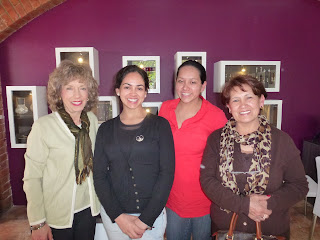
 
 Sue Gaither, Andrea Tello, Ma. Caridad Tello (Andrea's sister) & Miriam Guilen

Her gift of art, coupled with crafting this unique jewelry opened up a world for Andrea that has made her work known around the world.  The heart behind her work is as astounding as the pieces themselves.  At present, Andrea has employed 14 families in Cuenca, who have been trained by her to craft her designs. 

Until about five years ago, Andrea crafted and manufactured all of the designs herself.  But due to other countries now wanting to purchase her jewelry, it led her to open up a door for Cuencana families to be involved.

She is happy that she now can include other people in her endeavor, as it gives them an opportunity for employment.  It also gives them a sense of pride in their community and as well as in their work.  She takes about 3 to 6 months to train her employees at her home.  There they are also given the material to work with and asked to sign a "Comercio Justo" Agreement.  This states they will not copy her designs for resale.  She's had good experience with her employees and is honored to have these families work with her.

Andrea's first recognition for her work came in 2010.  One week before the event was to be held, someone told her of a competition hosted by UNESCO in Quito.  

 UNESCO (The United Nations Education, Science, and Culture Organization) is a specialized agency of the United Nations.  Its purpose is to contribute to peace and security by promoting international collaboration through education, natural sciences, social and human sciences, culture, and communication.  They give awards to and for handicrafts in countries around the world.  

In 2010's competition, Ecuador's Ministry of Industries and Productivity (MIPRO) participated with their entries among which Andrea's jewelry was presented.  Bolivia, Peru, and Venezuela were also countries represented at this event.  The entries included crafts of textiles, ceramics, wood, natural fibers and jewelry.  

Andrea received UNESCO's Award of Excellence for jewelry among fifteen, who were recognized in this competition.  This recognition was awarded to Andrea for excellence, authenticity, innovation, commercial potential, respect for the environment, and social responsibility.


After this first recognition from the prestigious UNESCO, she was invited to another premiere event in Lima Peru, where she was awarded as one of the best artisans in the country of Ecuador
In September of 2011, Andrea was invited to Paris, France to participate in the largest designer show in Europe.  At this show, major companies from around the world come to purchase products.  At the end of the event, Andrea had sold everything she brought to the show along with orders for more jewelry.    Also, there were movie producers and designers at this event and she was given the opportunity for further exposure to her unique creations.

After returning from Paris, she returned to Cuenca only to immediately return to Paris in November of 2011 to participate in the 10th Anniversary of Diversity Cultural in the World.  This event was hosted by and in the UNESCO Building in Paris.  This is the most prestigious affair since only the Prime Ministers from around the world were invited to attend - it was not open to the public.  Because of this honor, she now has received open doors for her jewelry in other countries.


In a whirlwind return to Cuenca, she was then invited the next month by the mayor of Jerusalem and traveled to Israel to give an exhibit there.  Andrea's collection was also included in an exhibition in the famous Lourve in Paris, France as pictured below.


In 2012,  the highest honor came for Andrea when she was named as one of the five best artisans in the world.  


There are other events Andrea has participated in since 2010, but now her traveling days have slowed tremendously.  She states that since her jewelry is now known in other countries and selling, she wanted to fulfill her dream to open a store in the city of Cuenca - a city she so loves. Again, her passion is to preserve the culture and history of Cuenca regarding the indigenous people - especially the four remaining:  Cholas, CaƱarejas, OtavaleƱas, and Zuletas.

Andrea also has a beautiful family - her husband, Pedro, and son, Pedro Daniel.  She wants to be here for them. Her son is now 8 years old and has already shown a unique "eye" to the world of creativity - as he likes to draw.  Andrea says though he is surrounded in the world of jewelry, he's still "all boy," for he loves sports!

Please go by her store located at "La Esquina de las Artes " on Doce de Abril and Agustin Cueva.   The store is open Monday through Friday from 10am to 2pm and 3pm to 7pm; and Saturdays, 10am to 6pm.  She currently has a sale in her store of some beautiful pieces with a 20% and 40% discount.
. 
And... if you mention to her that you read about her store on this blog, she will give you an additional 15% except for the new designs.

 Andrea and Sue

You will enjoy seeing her unique store and gorgeous jewelry creation.  Best of all, you will enjoy meeting God's lovely creation:  Andrea Tello.


Wednesday, July 3, 2013

Ecuador Citizenship


Ecuadoran Citizenship

The Cuenca Chamber of Commerce (CCCuenca.com.ec) hosted a presentation discussing how to become a citizen of Ecuador. This allows you to obtain an Ecuadoran passport. Dual citizenships are allowed in Ecuador and the US.

We may begin the process three years after receiving our Cedula. 

Application must be completed in Quito and the final step of being photographed and getting citizenship papers must also be done in Quito. The process may take 6-7 months.  Total cost is round $1,000, including $200 application fee, $500 naturalization letter, about $250 in notary fees, plus miscellaneous fees.

There are ten paperwork requirements:
1.       Birth Certificate obtained in US and apostatized. Canadians are not subject to apostile requirement by treaty. All other documents may be obtained in Ecuador!
2.       Notarized passport
3.       Notarized Cedula with proof of underlying requirements. Jubilado requires last six months of bank statements showing Social Security deposits.
4.       SRI Certificate (no taxes owed)
5.       Index card issued by Civil Registry
6.       City Hall certificate (no taxes owed)
7.       IESS(social security)  Certificate (no taxes owed)
8.       Ecuador criminal record
9.       “Migratory Movement”  record of international travel based on passport records
10.   Four passport photos with white background.

No tests are required. Only paperwork is required for the process. (Continue learning Spanish-it’s good for you!)

Sorta gives you warm international feeling of freedom, doesn’t it?

Sunday, June 30, 2013

Coopera Deposits & CD's

               COOPERA Deposits and CD's (as they mature)

This information appears on the government website (per Google translate):
                   www.seps.gob.ec

According to the payment schedule submitted by the liquidator, as of July 1 members and creditors of the Savings and Credit Cooperative "COOPERA Ltd.", in Liquidation, begin to recover their deposits.During this first phase will be returned deposits partners at time of settlement had balances of up to $ 10,000 (ten thousand dollars) through seventeen points enabled the effect in 11 cities in the provinces of Azuay and Guayas.Information on the dates and places where every member will receive your deposit, will be detailed in the list to be published on the website of the Superintendency of People's Solidarity Economy: www.seps.gob.ec.In order to carry out an orderly process, defined as the return of funds schedule will be made considering the last digit of the identity card or passport, according to the following table:

Last
digit          
Payment dates
 1         
Monday & Tuesday July 1st July 2nd
 2         
Wednesday, 03 July and Thursday July 4
 3
         Friday, 05 July and Monday July 8
 4         Tuesday, 09 July and Wednesday 10
 5  
      Thursday July 11 and Friday July 12

  6         Monday July 15 and Tuesday July 16
 7  
      Wednesday July 17 and Thursday July 18
 8  
      Friday, July 19 and Monday July 22
 9         Tuesday July 23 and Wednesday July 24

 0      
   Thursday July 25 and Friday July 26

 Everyone    August 5 Monday to Friday 9 August

 
As of July 1, will be available to the public telephone service user care (07) 417 73 29, extension 7101 "Co Ltd." in the Clearance and SEPS (02) 3948840 option 1, a through which questions and concerns will be met on this phase of the return.

After this first phase report on the process for depositors and members with balances over $ 10,000

The Superintendency of People's Solidarity Economy safeguard the stability, robustness, transparency and proper functioning of the organizations of popular and solidarity economy.

    That is all we know for now....


Sunday, June 23, 2013

Who Should Not Come to Ecuador


? Who Should Not Come to Ecuador ?

          Ecuador enjoys a unique collection of attractive characteristics, while sharing many traits of Latin America. But, we must ask the question, “Who will not enjoy living here?”
          Many of my US friends constantly make comments like:
                   “Do you have to learn the language?”       
                   “But that’s not like our beautiful mountains, etc.”
                   “How do you get used to the _____?”
                   “That sounds a little scary. Are you safe?”
                   “Won’t you miss your family?”
          It all depends on how you are wired and the size of your comfort zone. So, pause, if these questions are more motivating than the potential comments of:
                   “How exciting!  Are the people friendly?”
                   “What is the culture like?”
                   “What else impresses you in South America?”
                   “What is the weather like?”
          Ecuador requires a simpler, slower life style. We must recognize that the culture will change us, not the other way around. So, ask yourself some penetrating questions:
          Are you willing to become more flexible, and tolerant of others and yourself?
          Do you require constant focus on your family (a good thing)?
          Are you energized or frustrated by change?
          Do you want to initiate new relationships?
          Are conveniences a major concern?

Often the impressions of close trusted friends may give you an insight. “That sounds like something you would do.”  Or “You have never done anything like that before!”
          If in doubt, do what gives the most peace.

                    Come for a visit and discover yourself!


Sunday, May 12, 2013

Mother's Day Tea

What if we'd never come to Cuenca?  If so, we would not have met the beautiful ladies who came to our apartment Friday, May 10th.  They came because they were invited to be honored at a tea for Mother's Day.  With colors of purple and yellow, chocolate mocha cake (by Gary Huddleston) and Sue's carrot cake, lemonade punch made with vanilla ice cream, background music, the festivity began.
 
What happens when you bring Ecuadorians and Americans then for a Mother's Day celebration?  Plenty!  Laughter, tears, and joy through sharing stories of our mothers or being a mother.
 
It was a special time as the ladies shared in both languages - English & Spanish (with translation)!  Yet there is so much the same in both languages and cultures:  hearts, feelings, expressions, and being real! 
Since several daughters attended along with their mothers, there was a special time of their sharing what their mothers mean to them.

Elisa sharing how she in her busyness did not take the time to let her Mom know what she means to her.
 
And Mom, (Margarita) being deeply touched! 
 And after the second daughter, Caroline shares, it's time for a hug session! 
Margarita, Elisa and Caroline listening as others share their touching stories 
 
The door opened then for Sarah and her daughter, Dayana to share and have their special time as well!
 
Sarah shares openly about being a mother!

 
 Now it's time for Sarah and Dayana to have their hug session!
 
 
Tricia is getting ready to be a mother again!  She shared tearfully how watching her 17 month old son develop as a human being, with his little hands and mind.  It's the greatest joy of her life.
 
 
What another joy to watch Americans and Ecuadorians intermingle simply as women sharing the same things in life - same struggles, same desires, same hearts!
 
 
Of course, we share the same "clowning around!"  Karen and Sue break into dance to the song, "You've Got a Friend in Me," - just like a mother always is - a friend!


There's always a finale to everything - even to the Mother's Day Tea! 
 
At the end of our tea and special time together, each lady was presented with a handmade chocolate (dark chocolate!) and a song to honor mothers, written by Sue. 
 
 
And what about my own mother?  She's in a nursing home in the USA (Alabama) at age 90.  She is special to all of the four children.  This is the hard part about being in Cuenca, Ecuador -
I'm not with my Mom.  But she's in my heart!
 
So I put together a mother's day tribute for her and all mothers.  Since the file is a little over the limit for blogger, there is a link to YouTube below the next picture if you'd like to view it.


Happy Mother's Day to you, Mom and all mothers everywhere!


Thursday, May 2, 2013

Real Estate - Purchase or Rent?


Real Estate
Purchase or Rent? 
          This chapter was included in our ebook, Thriving in Ecuador (see sidebar), but I should have added it to the blog last year.
Most expats rent for six months to a year before considering the purchase of a home or departmento.   Many expats begin looking for a home to buy as soon as they arrive, the risk may be that they later decide Cuenca is not for them.  If this happens, there can be a problem selling quickly, especially if they paid too much (with fees) for the property in the first place, or if it is a rural property.  Rural properties take longer to sell.
          We rented a furnished casa with a yard for our dog for four months while learning the city. We were on the outskirts on a bus line by the river. The number 16 bus became our friend as we observed the city and its inhabitants daily.
          Our decision to purchase an apartment was based on several personal factors:
1.     To lock the price during inflation. Homes are too great a value to wait long ($ 60 to $100/sq.ft). INFLATION MAY CONTINUE!

2.     For a permanent home and place for our cargo to arrive. We chose a close in rentable location in the event our needs change.
 
3.     Apartments are more secure than homes. Our trips to the US last for a month.

4.     We have 24 hour guards and an elevator.

5.     Close to Centro, but away from bus fumes, traffic and most noise. Beautiful walking neighborhood.

6.     Property taxes are quite low.  Our taxes on the apartment we purchased are $120 per year.

Some folks chose to rent for many reasons.
1.     To avoid tying up available capital. Mortgages are rare and expensive.  Mortgages are hard to quality for and typically, have terms like 30% down, 12% annual interest, and a 15 year term.

2.     Unsure of permanence of location within city or Ecuador.

3.     Rent is very low relative to purchase prices ($250 to $600 unfurnished; $350 to $1000 furnished) depending on location and size). Cuenca is the high end city!

4.     Waiting a year or two for their new apartment to be built. Pre—construction prices are very attractive. The savings may be 15-20%.

Investors note that resale and renting may be very different for gringos vs. Ecuadorans:
1.     Ecuadorans have their appliances, furniture and household items. And a car!

2.      They are willing to live further out from Centro

3.     Terraces and balconies are low priority. Interior space is of higher value.

4.     They may be more flexible about noise, dogs and location.

5.     Gringos may need everything; prefer appliances provided.

6.     They want close in, within walking distance of historic district (Centro), shopping, and bus lines.

7.     Terraces are wonderful. Most are accustomed to outdoor living spaces.

8.     A peaceful street is a must for most. Bus and truck pollution is avoided.

Realtors are frequently unlicensed, untrained and may lack North American standards:
1.     Commissions may be expected from both buyer and seller.

2.     Mark ups in asking prices, extra fees and hourly charges must be negotiated in advance.

3.     There is no MLS, appraisal system or formal inspections.

4.     Title insurance and mortgages are rare and expensive.

Potential Problems may surprise you:
1.     Attorney’s rates and procedures vary widely. Clarify in advance.

2.     Liens may be undisclosed.

3.     Titles may come slowly, be delayed, etc.  Titles are required for a home ownership residency Cedula. And the “tax value” (usually less than half the true value) must be at least $25,000.

4.     Notary services are required to certify everything. “Appointments “may mean stand in line, wait until someone returns, etc.  Allow lots of time!

5.     Have a Spanish speaker review Apartment Association minutes for the last couple of years. Who knows what problems were mentioned?

6.     Cuancanos may expect to remain in the apartment for 1-3 months after you own it. Be a little flexible, but negotiate a large deposit to insure the

premises are clean and vacated on time.  Be sure to hold back some money until the owner has turned over the keys and the title is completed with any agreed upon repair.  Otherwise, these things can be delayed indefinitely.  The same is true for paying Real Estate agents, lawyers, contractors, or anyone in Ecuador. 

7.     Finally, be sure to walk your new neighborhood at various hours, especially Saturday night, to discover its true character.  Ask a Cuencano friend to visit neighbors with you too.

Utilities are difficult to initiate and may require delays:
1.     Internet is essential, but usually requires multiple requests for installation. Service varies widely throughout the city in speed and availability. ETAPA is usually good, but may not be available in your building. Ditto cable. Verify before commitment!

2.     Electricity should be requested at their office on Ave.Max Uhle near Veinticuatro de Mayo. Monthly payments may be made at credit unions or pago services.

3.     Gas and water may be included in your condo fee. Propane tanks are also available for delivery for two dollars (government subsidized)!

4.      Cuenca water is wonderful. Coming from the Andes it is drinkable and tasteless (rated the best in S. America).  Many of us also order five gallon bottles from Pure or others for two bucks.

5.     On demand hot water is installed in most homes and apartments. Propane is much cheaper, but be mindful of venting. Also true of clothes dryers, which are usually gas powered, since electric rates are higher.

          Used furniture and household items may be shipped one time duty free within six months of obtaining your Cedula (residency). More details are in our chapter on cargo.